Featured | Blog Post
State of Remote Engineering 2026: What 1,800+ Engineers Say About AI, Burnout, and Hiring
Natalie Fagundo
Share this post
Terminal’s State of Remote Engineering 2026 surveyed 1,800+ software engineers across Latin America, Canada, Europe, and the US. AI is now standard: 79% use AI tools frequently and 37% are AI-native. Engineers ship faster, but 42% feel more burned out than a year ago, and 95% plan to look for a new job within 12 months.
Engineers have never been more productive. They have also never been closer to burning out. That tension runs through every finding in this year’s report.
State of Remote Engineering 2026 vs. 2025
| Finding | 2026 | 2025 |
|---|---|---|
| Use AI tools frequently or almost always | 79% | 71% |
| Plan to look for a new job in the next 12 months | 95% | 92% |
| Confident in their own job prospects | 75% | 73% |
| Would encourage students toward a CS or engineering career | 69% | 76% |
| Expect AI to decrease long-term engineering hiring | 45% | 41% |
| Expect AI to increase long-term engineering hiring | 42% | 43% |
How are software engineers using AI in 2026?
AI is now a standard part of engineering work. 79% of engineers use AI tools frequently or almost always, up from 71% in 2025. 76% have built and shipped an AI-powered product or feature in their most recent role. Only 3.3% still write all their code by hand.
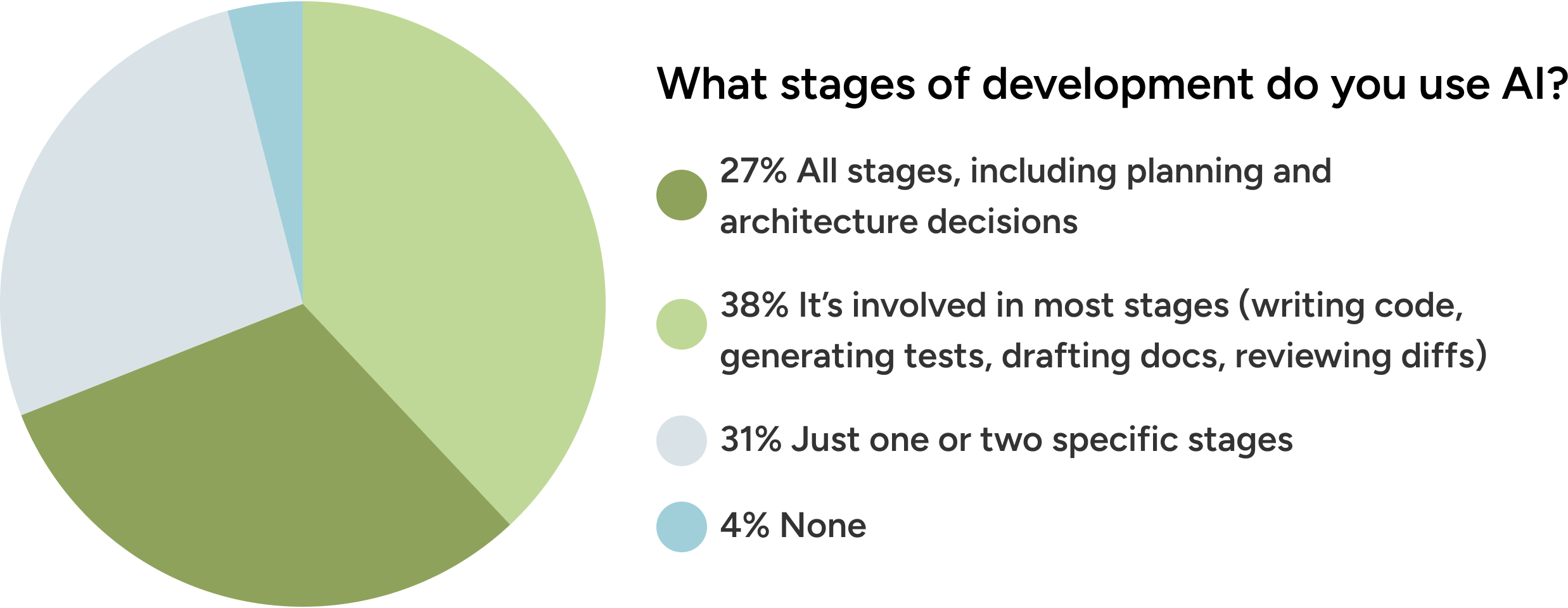
- Where AI shows up: 27% use AI at every stage, including planning and architecture. 38% use it in most stages: writing code, generating tests, drafting docs, and reviewing diffs. 4% don’t use it at all.
- Which tools: ChatGPT (59%) and Claude (58%) are used at similar rates. Claude Code is used nearly 2x as often as Codex, a clear preference for agentic coding tools.
- Employer support varies by region: 41% of US engineers say their employer runs AI learning programs or communities of practice. Only 24.6% of Latin American engineers say the same.
“AI writes most of the code now, so my day shifted from typing to steering… The tedious part got cheap, so the judgment part became the whole job.” — Survey respondent
What is AI fluency for software engineers?
AI fluency is an engineer’s mastery of AI code generation, agentic orchestration, and architectural governance. It means directing parallel agents, working across unfamiliar codebases, and keeping deep system ownership. Terminal’s AI Fluency Standard, launched in 2026, is the first framework that measures it for hiring global engineers.
| AI fluency level | What it means | Share of engineers (2026) |
|---|---|---|
| AI-native | Defines the goal and constraints; agents plan, build, test, and iterate | 37% |
| AI-enabled | Writes code manually; uses AI for debugging, research, or suggestions | 33.3% |
| AI-assisted | Writes code manually; uses AI for debugging, research, or suggestions | 26.5% |
| AI-inexperienced | Writes all code by hand | 3.3% |
It builds on the AI Fluency Framework developed by Anthropic with Professors Rick Dakan and Joseph Feller.
Is AI making engineers more productive?
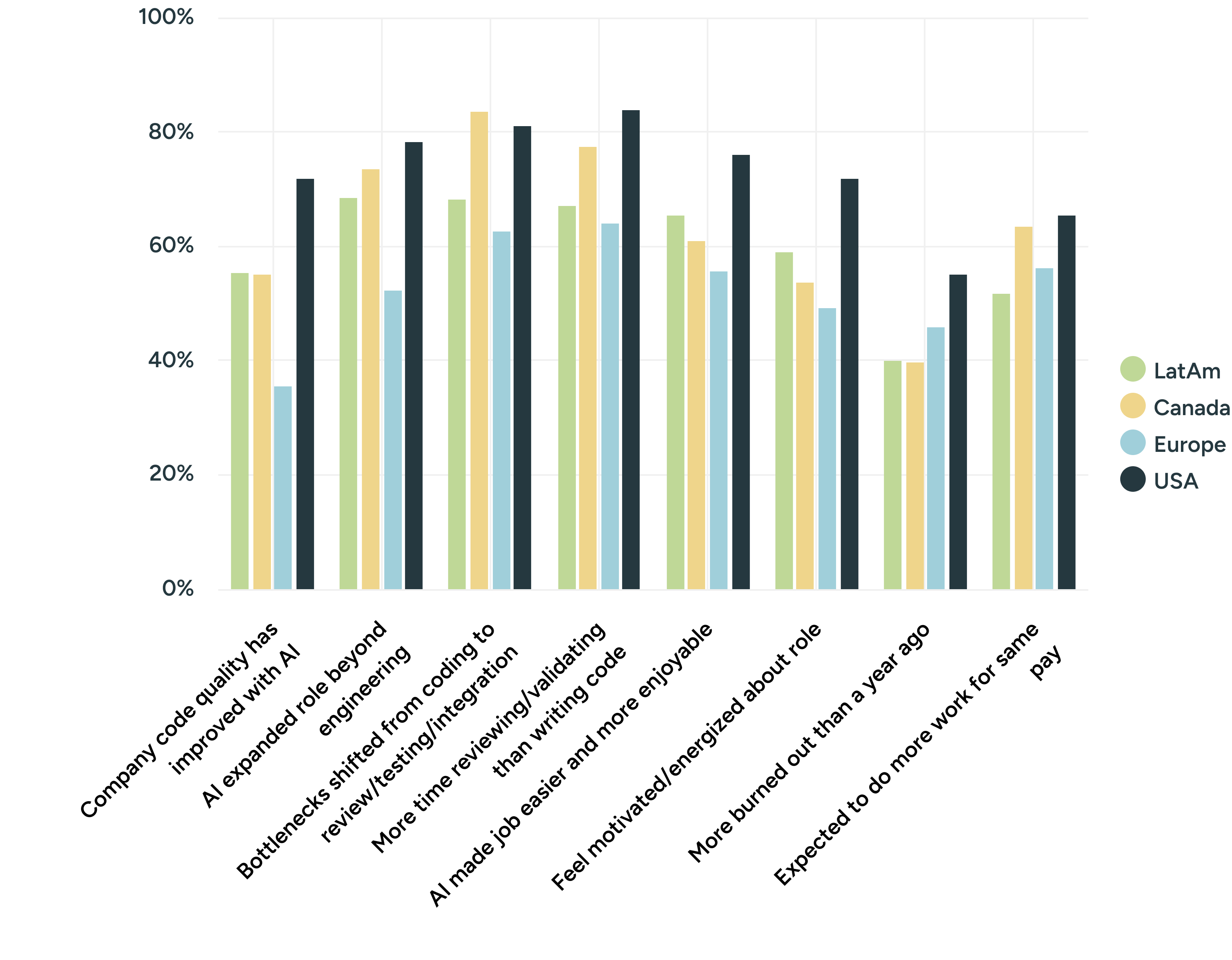
Yes. 84% of engineers agree AI has helped them ship significantly faster, and 77% say it has increased their capacity for higher-value work. The work itself has changed: 70% now spend more time reviewing and validating code than writing it.
- 77% learn new technologies faster with AI.
- 72% say bottlenecks moved from writing code to review, testing, and integration.
- 68% say AI made the job more enjoyable.
- 75% say they still hold a strong grasp of foundational development skills.
Is AI causing burnout among software engineers?
Yes, for a large share. 42% of engineers feel more burned out than they did a year ago, and 57% say they’re expected to do more work for the same pay. Burnout is highest in the US at 55%. AI is increasing engineering capacity without reducing the demands on engineers.
Retention is the downstream risk. 95% of engineers plan to look for a new job in the next 12 months, up from 92% in 2025.
“Since writing code has become so cheap, we’re expected to ship more code than ever before… Reviewing takes significantly more cognitive energy.” — Survey respondent
How is AI affecting software engineering hiring?
Mostly by slowing it, outside the US. Only 19.1% of engineers say AI increased hiring at their company. 31.8% saw hiring slow and 31.2% saw personnel reductions due to AI. US engineers are the exception: 41.7% say AI increased hiring where they work.
Regional results from the State of Remote Engineering 2026:
| Region | AI increased hiring at my company | Expect AI to increase long-term hiring | Expect AI to decrease long-term hiring |
|---|---|---|---|
| US | 41.7% | 53.9% | 33.9% |
| Latin America | 13.9% | 41.2% | 45.0% |
| Europe | 11.8% | 32.7% | 52.1% |
| Canada | 9.4% | 28.9% | 58.5% |
Do engineers trust AI interviewers?
Most don’t. 56% of engineers have been interviewed by AI, but only 10% completely trust an AI interviewer to assess skills fairly. 37% say an AI interviewer would make them less interested in an employer. Engineers prefer take-home challenges (35%) and live technical sessions (27%) over AI interviews (14%).
What do software engineers want from employers in 2026?
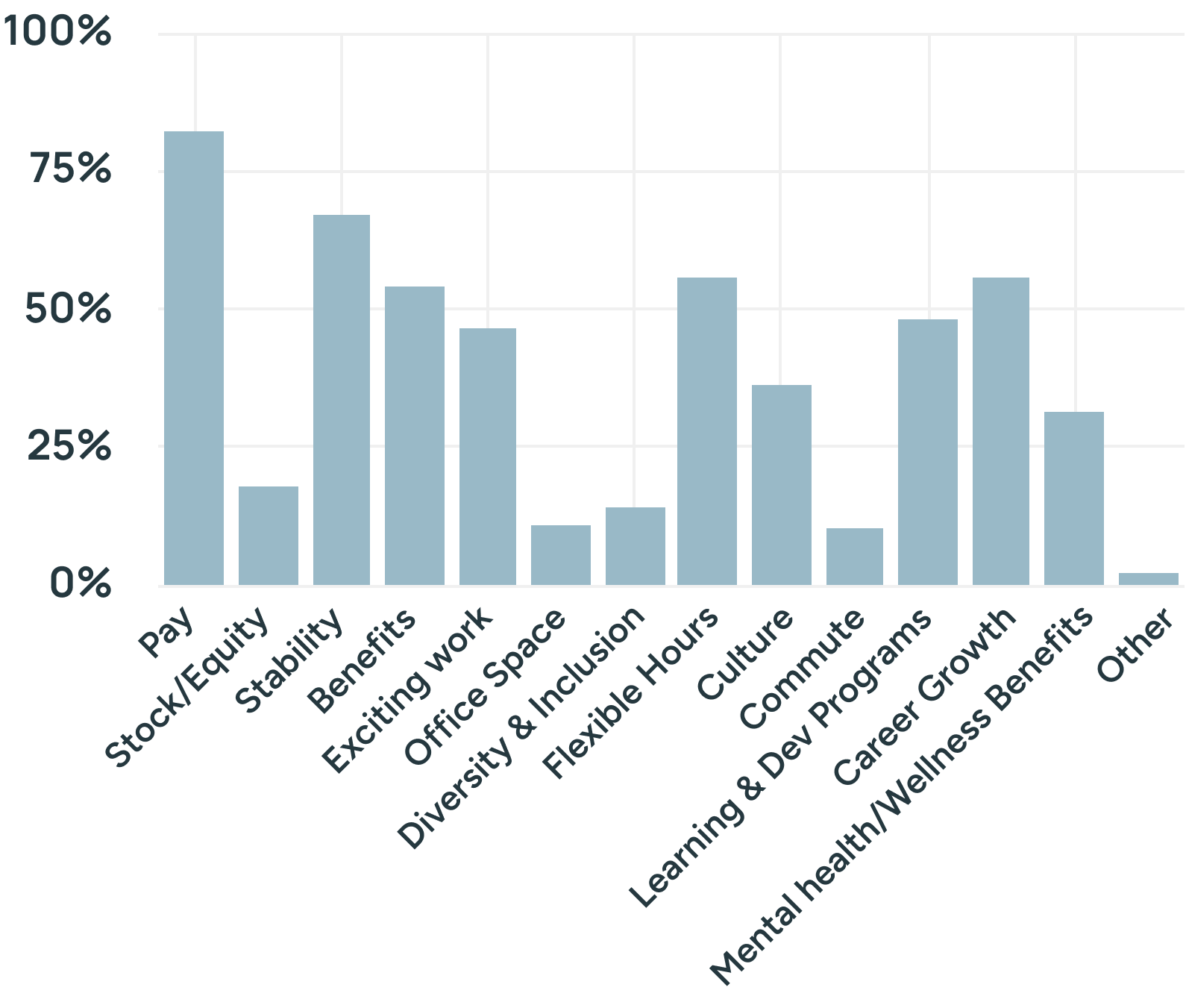
In the State of Remote Engineering 2026, pay comes first. 81% of engineers rank compensation as a top-five factor when choosing an employer. Stability (67%), flexible hours (56%), career growth (55%), and benefits (54%) follow. Just over half are extremely or somewhat satisfied with their current compensation.
- Latin America: puts more weight on benefits and stability than US engineers do.
- Europe: most motivated by flexibility (63.9%) and exciting work (60.4%).
- Canada: ranks culture (44.5%), career growth (59.8%), and commute (18.8%) higher than other regions.
For pay benchmarks by country and role, see Terminal’s Remote Software Engineer Salaries.
What should engineering leaders do with the State of Remote Engineering 2026 data?
Hire for AI fluency, protect your team’s capacity, and keep humans in the hiring loop. The data points to four moves for CTOs and talent leaders in 2026.
- Implement AI without overloading your team. 57% of engineers are doing more work for the same pay. Decide where AI adds leverage, and don’t treat it as a replacement for engineers.
- Keep humans in the interview. Only 10% of engineers fully trust AI interviewers, and 37% lose interest in employers that use them. Use AI to speed up hiring, not to run it.
- Close the AI training gap. Only 24.6% of Latin American engineers get structured AI learning from their employer, versus 41% in the US. US employers that offer AI training and enablement win global talent.
- Compete on more than pay. Pay drives 81% of job decisions, but stability, flexible hours, and career growth each matter to more than half of engineers.
“If we want to keep the best engineers, the job has to get better, not just faster. Top global engineers are drawn to building with AI. Companies that offer those opportunities, backed by training and enablement, will win over the best talent.” — Dylan Serota, CEO, Terminal
Hire AI-fluent engineers with Terminal
Terminal vets every engineer against the AI Fluency Standard, so you see who is AI-native before the first interview. Hire full-time or contract engineers across Latin America, Canada, and Europe at 40–60% less than US salaries, with payroll and compliance handled.
- Browse AI-fluent engineers by skill →
- Compare remote engineer salaries by country →
- Download the full 2026 report →
Frequently Asked Questions (FAQ)
It is Terminal’s annual survey of software engineers worldwide. The 2026 edition covers how engineers use AI, burnout, job market
The largest groups of respondents are from Colombia (21%), Mexico (18%), Canada (14%), the US (10%), and Poland (6%). Results are reported for four regions: Latin America, Canada, Europe, and the US.
3.3%. Nearly all engineers now use AI in their workflow. 37% work AI-native, meaning they set the goal and constraints while agents build, test, and iterate.
37% of engineers surveyed are AI-native under Terminal’s AI Fluency Standard. About one-third are AI-enabled and 26.5% are AI-assisted.
hatGPT (59%) and Claude (58%) are used at similar rates. Among agentic coding tools, Claude Code is used nearly twice as often as Codex. Many engineers use several tools in one workflow.
Yes. 95% plan to look for a new job in the next 12 months, up from 92% in 2025. Pay is the top factor: 81% rank it in their top five when choosing an employer.