Featured | Blog Post
Building Trust in Hiring: Terminal’s New Tool for Combating Candidate Fraud
Kevin Gunnerson
Share this post
As companies have embraced remote hiring and virtual interview processes, hiring teams have gained access to a much larger global talent pool. At the same time, evaluating candidate information has become more complex. Questions around candidate identity, profile accuracy, and data misrepresentation are becoming increasingly important for companies hiring remotely.
Gartner predicts that by 2028, one in four candidate profiles worldwide could be fake, while a recent Gartner survey found that 6% of job candidates admitted to participating in interview fraud.
To help address this challenge, Terminal recently launched the Candidate Risk Assessment, a suite of new internal risk assessment capabilities designed to help our Talent Partners and Talent Acquisition teams identify suspicious candidate activity and determine when additional review may be appropriate.
The Candidate Risk Assessment adds another layer to Terminal’s existing candidate vetting process. Our new tools evaluate a variety of signals collected throughout the candidate lifecycle and surface potential concerns for our internal teams before candidates are presented to customers.
The goal is straightforward: help our teams identify potential issues earlier so our customers can evaluate candidates with greater confidence.
Candidate Fraud is a Growing Concern
The broader market makes clear why this is becoming a more urgent concern for hiring teams.The launch of The Candidate Risk Assessment reflects both what we’re hearing from customers and what we’re seeing across the broader hiring landscape. Research points to a growing confidence gap:
Only 19% of hiring managers said they were extremely confident their current hiring process would catch a fraudulent applicant.
The potential impact also extends beyond wasted interview time or delayed hiring decisions. In one survey, 23% of companies reported losing more than $50,000 in a year to hiring or identity fraud, while 70% of managers said they believe hiring fraud is an underestimated financial risk. In more serious cases, candidate misrepresentation can also create security and reputational concerns.
It is becoming a central challenge for talent acquisition leaders as well. GoodTime’s 2026 Hiring Insights Report found that fraudulent or AI-assisted candidates had become the top anticipated hiring challenge for 2026, surpassing even the longstanding challenge of finding qualified talent.
Prospective and existing customers regularly ask how Terminal approaches candidate authenticity and data accuracy. At the same time, candidate misrepresentation is becoming more prevalent across the hiring industry, creating new challenges for companies that recruit remotely. Investing in the Candidate Risk Assessment was a natural next step for our platform.
A New Layer of Candidate Review
Before candidates are introduced to customers, our Talent Partners review each candidate’s profile, communication skills, professional and technical experience, and other factors to help determine whether they’re ready to move forward.
The Candidate Risk Assessment builds on that process by providing our teams with additional signals to consider during candidate review. The assessment looks at a variety of information, including IP and VPN information collected during in-person screens, language and time zone settings, and comparisons against other known candidate profile data sources.
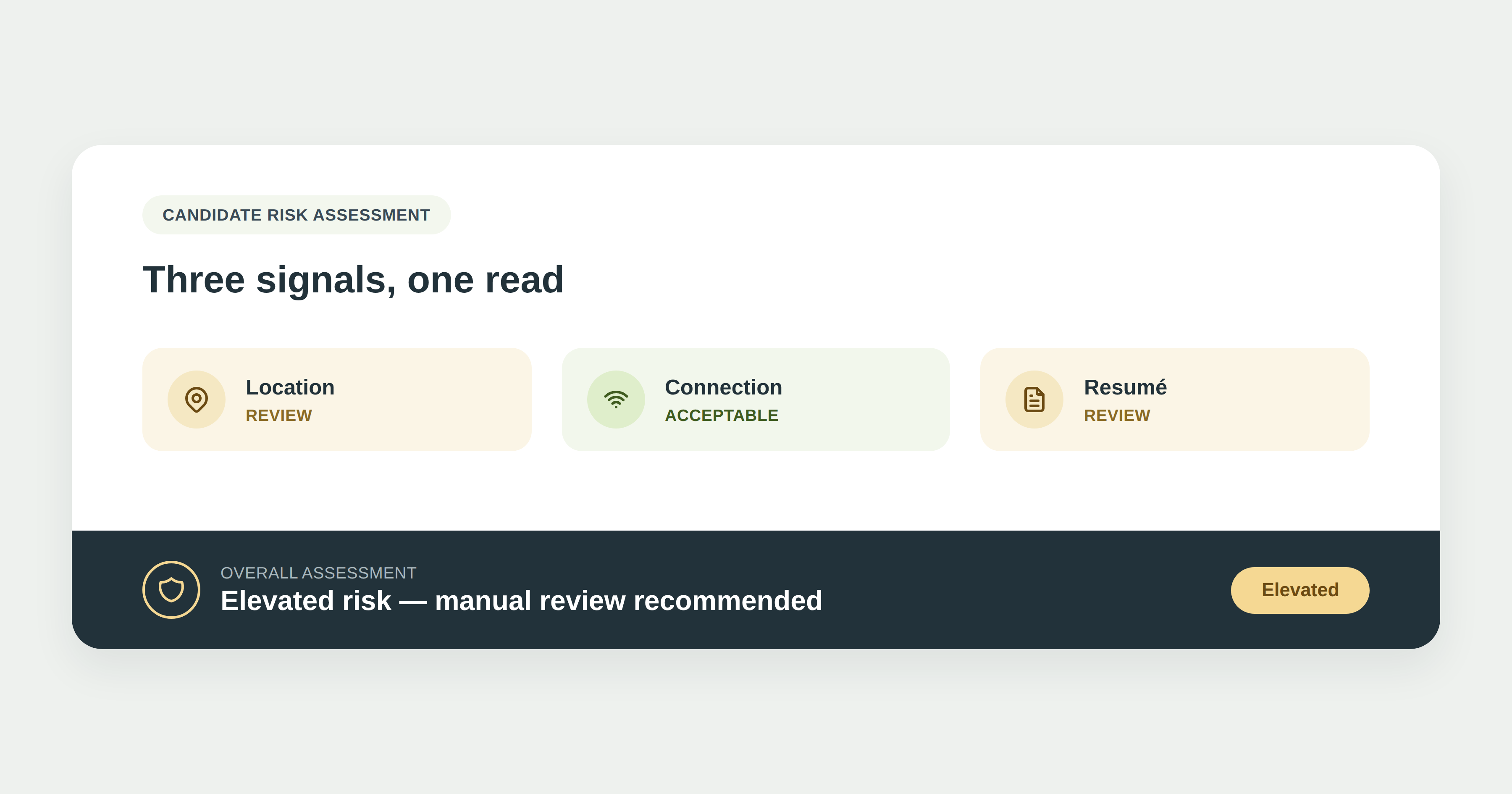
Terminal’s Candidate Risk Assessment combines these and other signals into a numeric Risk Assessment score. Lower scores indicate lower levels of identified risk, while higher scores indicate that additional review may be warranted. Scores are grouped into four categories:
- Clear: No risk concerns identified
- Elevated: Signals that may warrant additional review
- High: Multiple or more significant signals requiring closer review
- Critical: Significant signals requiring careful investigation
The Candidate Risk Assessment does not make an automatic determination about a candidate. A risk score or category is a signal for our internal teams to investigate further, and the presence of a risk assessment does not necessarily mean that a candidate has engaged in malicious activity.
Giving Our Teams More Context
When our Talent Partners encounter a candidate with an Elevated, High, or Critical Risk Assessment, they can review the factors that contributed to the assessment. The assessment also includes an AI-generated narrative summarizing what was identified and highlighting areas our teams may want to review.
This gives Talent Partners additional context without requiring them to manually piece together information from different parts of the candidate record.
The Candidate Risk Assessment also automatically updates at various points throughout the candidate lifecycle as additional information becomes available. This allows the assessment to incorporate new signals as we learn more about a candidate.
The Candidate Risk Assessment is now part of the daily workflow for Terminal’s Talent Partners and Talent Acquisition teams. It is designed to support the people already responsible for reviewing candidates and making decisions about whether they are ready to move forward in our process.
What This Means for Terminal Customers
The Candidate Risk Assessment operates entirely within Terminal’s internal workflows, but the benefit extends directly to our customers.
Our customers rely on Terminal to connect them with exceptional global talent. Before candidates reach those customers, our teams have already reviewed candidate information and investigated potential concerns. The Candidate Risk Assessment gives those teams another set of tools to help identify suspicious activity and determine when additional investigation may be appropriate.
No process can eliminate every instance of candidate misrepresentation, and a risk signal is not proof that a candidate has done something wrong. Our goal is to be proactive and thoughtful about identifying potential concerns before they become a larger problem.
For hiring teams, that means another layer of diligence between candidate sourcing and customer consideration.
Continuing to Invest in Hiring Trust
The Candidate Risk Assessment is a recent addition to Terminal’s talent platform, but our work in this area will continue.
As remote hiring evolves, so will the ways that companies think about candidate identity, profile accuracy, and trust. We’ll continue refining our internal tools and processes as new information becomes available and new patterns emerge.
We’re also monitoring emerging technologies and approaches, including areas such as deepfake detection, that may become valuable additions to candidate review in the future.
For Terminal, building trust is an ongoing investment. The Candidate Risk Assessment is one more way we’re equipping our teams to protect that trust and give customers greater confidence in the talent they spend their time evaluating.
Building hiring trust starts before the first interview. We’re committed to continuing to raise the bar.
Frequently Asked Questions
Candidate fraud occurs when someone intentionally misrepresents their identity, experience, qualifications, location, or other information during the hiring process. In more serious cases, it can involve someone posing as another person or using deceptive methods during interviews or onboarding.
A candidate risk assessment is a review that looks for signals or inconsistencies that may warrant additional attention. Terminal’s Candidate Risk Assessment combines a variety of signals into a score to help internal teams identify candidate profiles that may need further review.
Candidate fraud and data misrepresentation are growing concerns across the hiring industry, particularly as remote hiring and virtual interview processes become more common. Research suggests that many hiring teams have encountered or suspect candidate deception, though the exact prevalence varies by role, industry, and the type of activity being measured.
Resume exaggeration can include overstating experience, skills, or responsibilities. Candidate fraud generally refers to more intentional or significant forms of deception, such as misrepresenting identity, location, credentials, or having someone else participate in an interview. The distinction can depend on the specific facts and circumstances.
Terminal’s Candidate Risk Assessment uses proprietary internal tools to help identify signals associated with suspicious candidate activity and potential data misrepresentation. We do not disclose the specific methodology or how individual signals are weighted, and potential concerns are reviewed by our internal teams rather than automatically treated as proof of wrongdoing.
The assessment considers a variety of signals collected throughout the candidate lifecycle. These can include information such as IP and VPN data from in-person screens, language and time zone settings, and comparisons against other known candidate profile data sources.
The Candidate Risk Assessment groups scores into four categories: Clear, Elevated, High, and Critical. Clear indicates no risk concerns were identified, while higher categories indicate increasingly significant signals that may warrant additional review by Terminal’s internal teams.
No. A high risk score does not mean Terminal has determined that a candidate is committing fraud or has engaged in malicious behavior. The score is designed to surface signals that may warrant additional review and help our teams determine whether further investigation is appropriate.
The Candidate Risk Assessment adds another layer to Terminal’s candidate review process before candidates are shared with customers. It helps our internal teams identify potential concerns earlier, giving customers greater confidence in the candidates they spend time evaluating.