Demand | Blog Post
From Coders to Builders: Identifying and Expanding AI Maturity
Greg Vilines
Share this post
Somewhere over the last few months, the conversation in engineering leadership took an abrupt turn. For nearly a decade, the hiring playbook remained entirely unchanged: you looked for specific languages, specific domains, and specific stack depth. A typical brief requested a senior backend engineer with Python and distributed systems expertise.
Then, almost overnight, that crisp framework was replaced by a request that sounds clear but is incredibly murky in practice: “I need to hire someone who really knows how to use AI.”
To unpack what AI fluency actually means—and how organizations can realistically measure and absorb it—Dylan Serota (CEO and Co-Founder of Terminal) sat down with Paolo Bettoni (Vice President of Engineering at Digible) for a live webinar discussion. With Paolo’s 20-plus years navigating agile and cloud transformations and Dylan’s front-row view overseeing thousands of global engineering hires, the two walked through tactical frameworks for hiring in the AI-native era. Watch the full recording here or read on for key takeaways from their conversation.
The AI Maturity Matrix: An Organizational Mirror
When organizations rush to hire for AI expertise, they often fall into a binary trap of classifying engineers as simply “using AI” or “not using AI.” To establish a more granular language, Paolo’s team at Digible built upon a framework popularized by Dan Shapiro, which maps individual software development automation across distinct tiers.
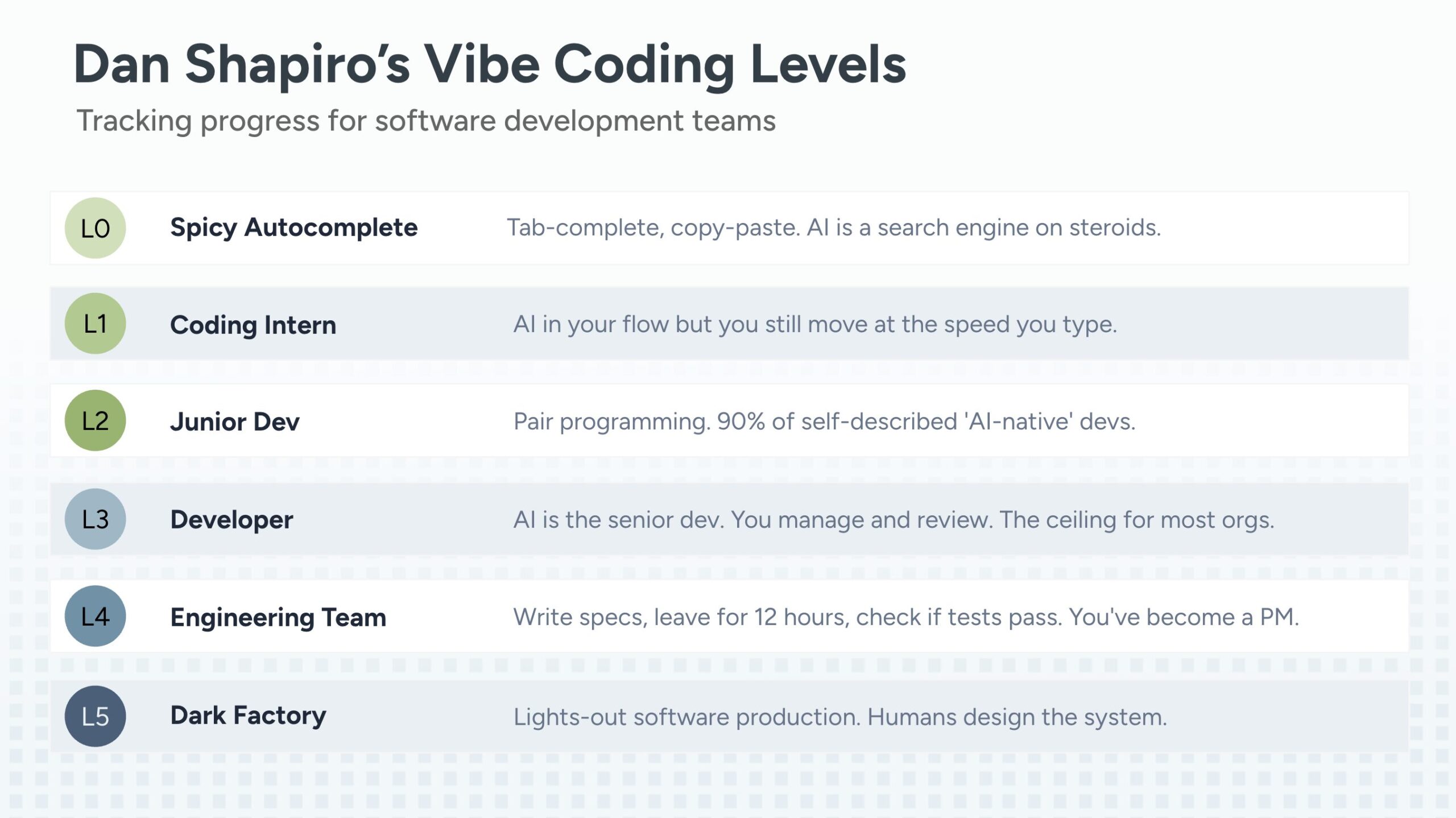
The executive trap is pointing at L5 and mandating it as the hiring target. But Paolo warns against this mismatch with a blunt restaurant analogy: Would you rather hire a burger flipper or a Michelin-star chef? Everyone wants the Michelin-star chef, but is the restaurant ready? An L4 or L5 engineer dropped into an organization with L1 infrastructure will not produce agentic breakthroughs. They will produce friction and experience profound frustration.
To solve this readiness problem, Digible constructed an AI Maturity Matrix that traces Dan Shapiro’s levels and helps leaders to look across two distinct axes rather than just tracking individual tool adoption.
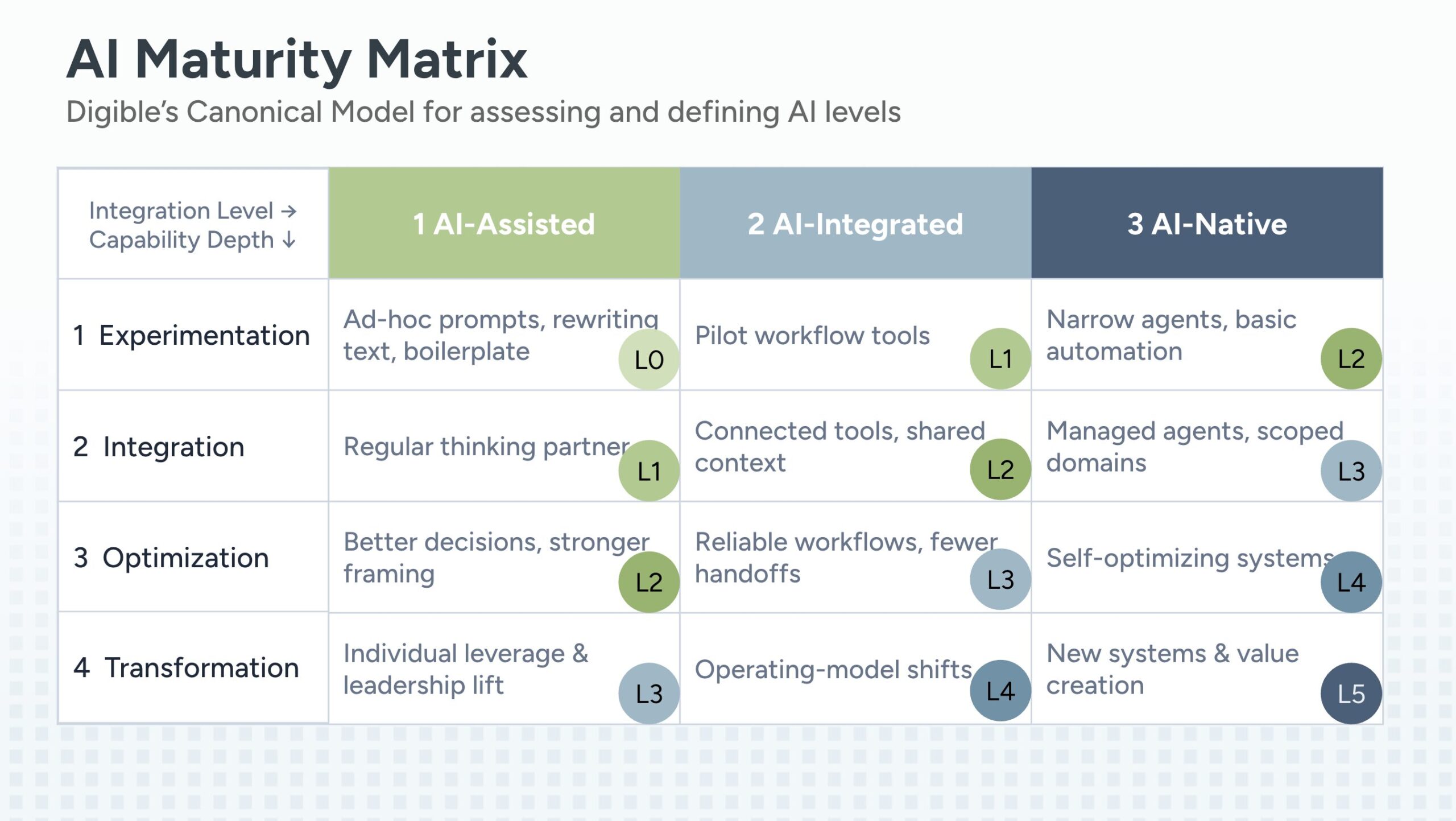
The horizontal axis focuses on Integration Level—how deeply AI can leverage your organizational knowledge. The vertical axis tracks Capability Depth—moving deliberately from ad-hoc Experimentation through Integration and Optimization until your daily operating model undergoes full Transformation. Most organizations are stuck in the top-left quadrant. You cannot simply hire your way to the bottom-right; your infrastructure must pave the way.
You Can’t Delegate Context Infrastructure
A common operational failure occurs when a leadership team mandates an advanced AI capability without doing the foundational documentation work. Paolo highlights this using a security example: Say you want AI to automatically identify vulnerabilities in your codebase. For that to work, your security posture must be rigorously documented, up to date, and structured so a model can reason against it. If your Chief Security Officer is stuck at Level 1 because those policies only live in their head, your entire downstream engineering team is capped at Level 1 too.
“If we can’t enable one person, the chance of enabling the team is zero.” – Paolo Bettoni
This structural reality places a new burden on leadership. Executives can no longer treat AI as an engineering initiative to be managed from afar via status slides. Dylan points out that to be an inspiring and effective leader today, you have to be utilizing and pressure testing AI yourself.
“You cannot be purely a people leader, you need to be hands-on with this technology.” – Dylan Serota
Two Crucial Distinctions and Shifting Bottlenecks
Throughout their conversation, Dylan and Paolo observed that companies routinely derail their budgets by conflating two parallel tracks:
- Value Creation (The Product Track): Infusing AI into the actual product shipped to customers—such as building user-facing chatbots, RAG systems, or classification models. This requires deep machine learning expertise and sharp product intuition.
- Value Capture (The Internal Ops Track): Using AI internally to rewrite how your team delivers work—compressing a three-hour code review down to twenty minutes or automating QA gates. This requires process discipline and rigorous change management.
When a job description simply asks for an “AI Engineer,” it typically muddies these tracks. Figure out whether you are solving a product problem or an operations problem before writing the job description, because the ideal developer profiles for each are fundamentally different.
Furthermore, leaders must prepare for the downstream realities of successful internal value capture. If your engineering velocity doubles or triples via AI orchestration, engineering ceases to be the organizational bottleneck.
If a team suddenly scales from shipping 100 changes a month to 500, the constraint immediately migrates downstream. Are your customer success teams trained to handle that release volume? Is your documentation infrastructure machine-readable to keep up? Is marketing equipped to enable sales? Without planning for this systemic cascade, you simply pile up unabsorbed inventory, and the expected business value stalls completely.
Turning the Knobs: How to Move Safely
If a board or CEO hands down a mandate to “become AI-native in six months,” how do you execute without breaking the core business?
Paolo’s direct advice is: Don’t try to force the incumbent business at that speed. The institutional weight, legacy dependencies, and immediate revenue pressures will generate massive resistance.
Instead, shield a small, dedicated team from those operational constraints. Ask them to approach the problem as if building the business unit entirely from scratch. Let them move fast, uncover real friction points, and feed those structural insights back to the parent organization in structured intervals.
Terminal took this exact approach by standing up its internal AI Fast Forward unit—assembling one representative from every operational function. They dedicated the first quarter entirely to open cross-functional experimentation and tool exploration to expand the organization’s sense of what was actually possible. Only in the second quarter did they pivot to formal value capture, methodically integrating the most viable prototypes back into stable team workflows.
Unlike the historical milestone of a cloud transformation, AI deployment has no fixed finish line. Paolo provides great advice for keeping up with the new tools and the information overload that comes with AI right now: Establish a sustainable cadence that works for your team, maintain curiosity, and focus entirely on making steady operational progress.
“Have a cadence by which you stay updated that works for you and allows you to make progress.” – Paolo Bettoni
Assessing AI Fluency at the Source
To bring objectivity to this transition, Terminal has formalized these observations into a measurable AI Fluency Standard, explicitly screening global talent for AI usage and shipped AI-powered products. With data collected directly from engineers through our structured candidate onboarding and live interview screening process, our AI fluency standard classifies engineers into three AI fluency levels:
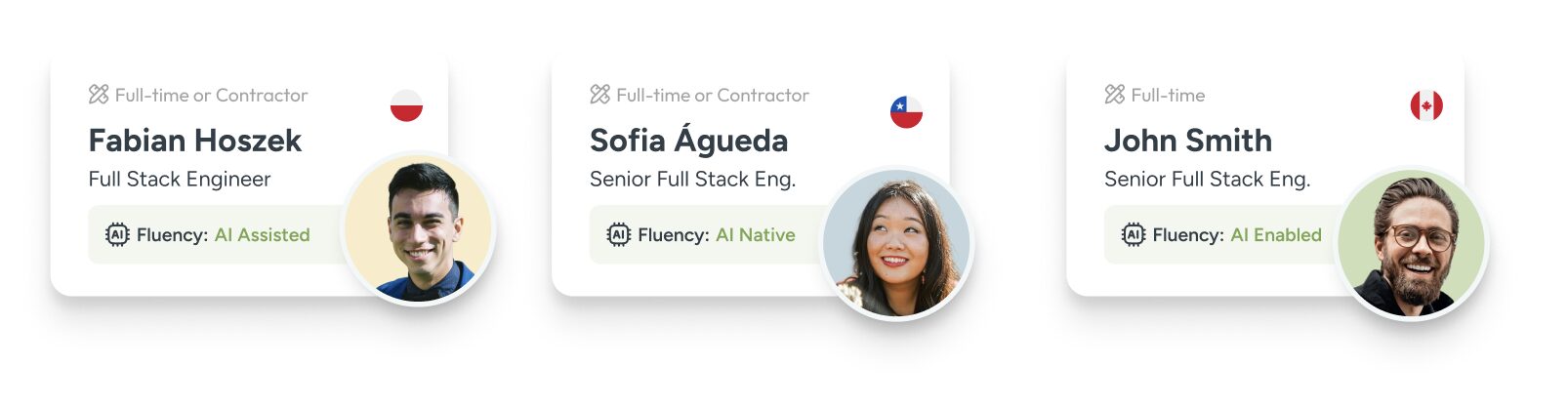
- AI Assisted: Developers who still manually write their code and use AI for debugging, research, or suggestions.
- AI Enabled: Engineers who regularly use coding assistants like Claude or Cursor to move faster and improve output.
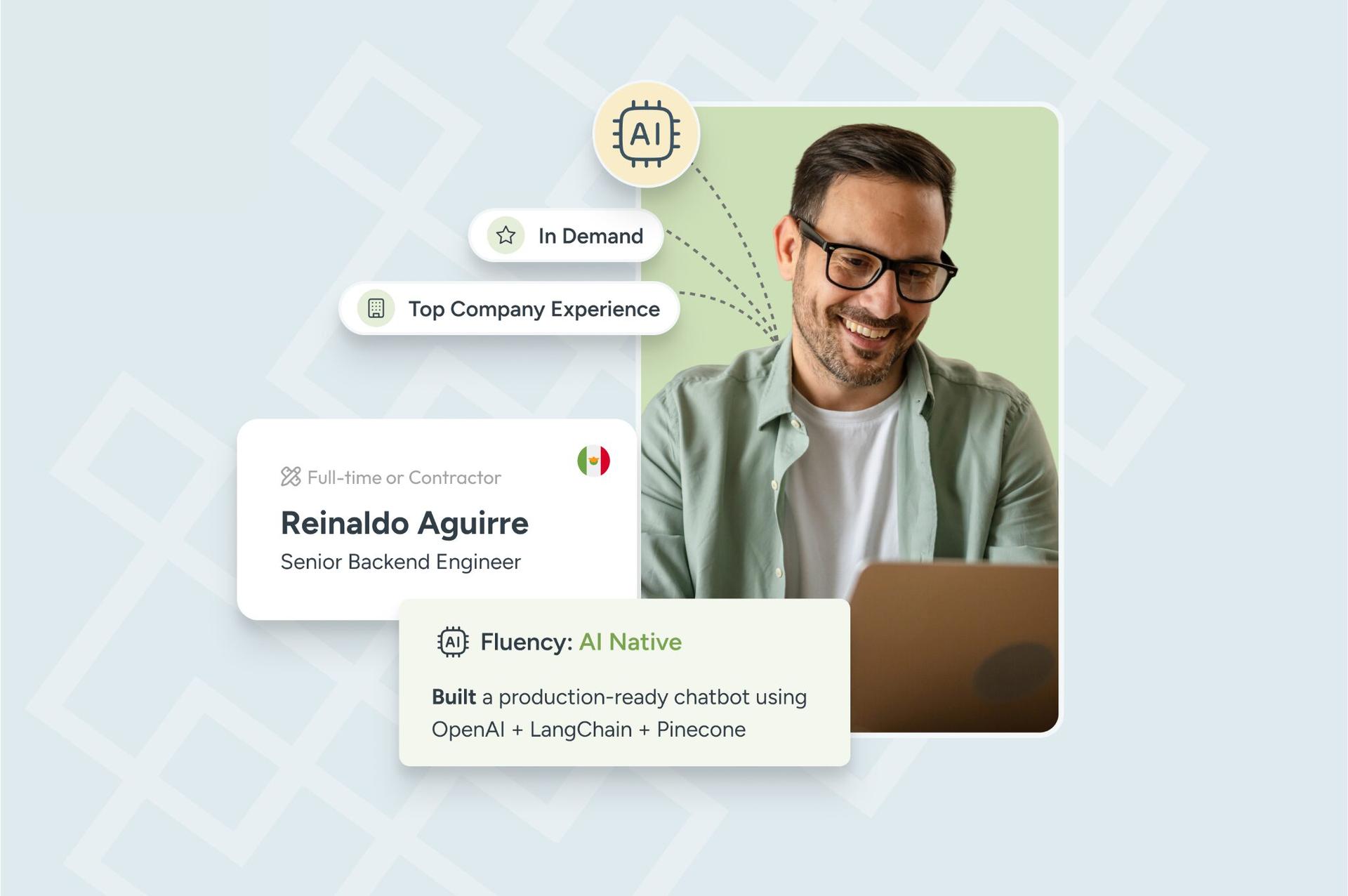
- AI Native: Builders who lead with agentic delivery for the entire lifecycle, from planning and prototyping to coding and pull request reviews.
We also showcase real AI-powered products our engineers have built and shipped with shipped AI products highlights and badges. With this information, you can quickly find vetted candidates who have shipped AI-powered products, RAG systems, or AI models themselves. You can easily search and filter for the best AI fluent talent in our Talent Hub here.
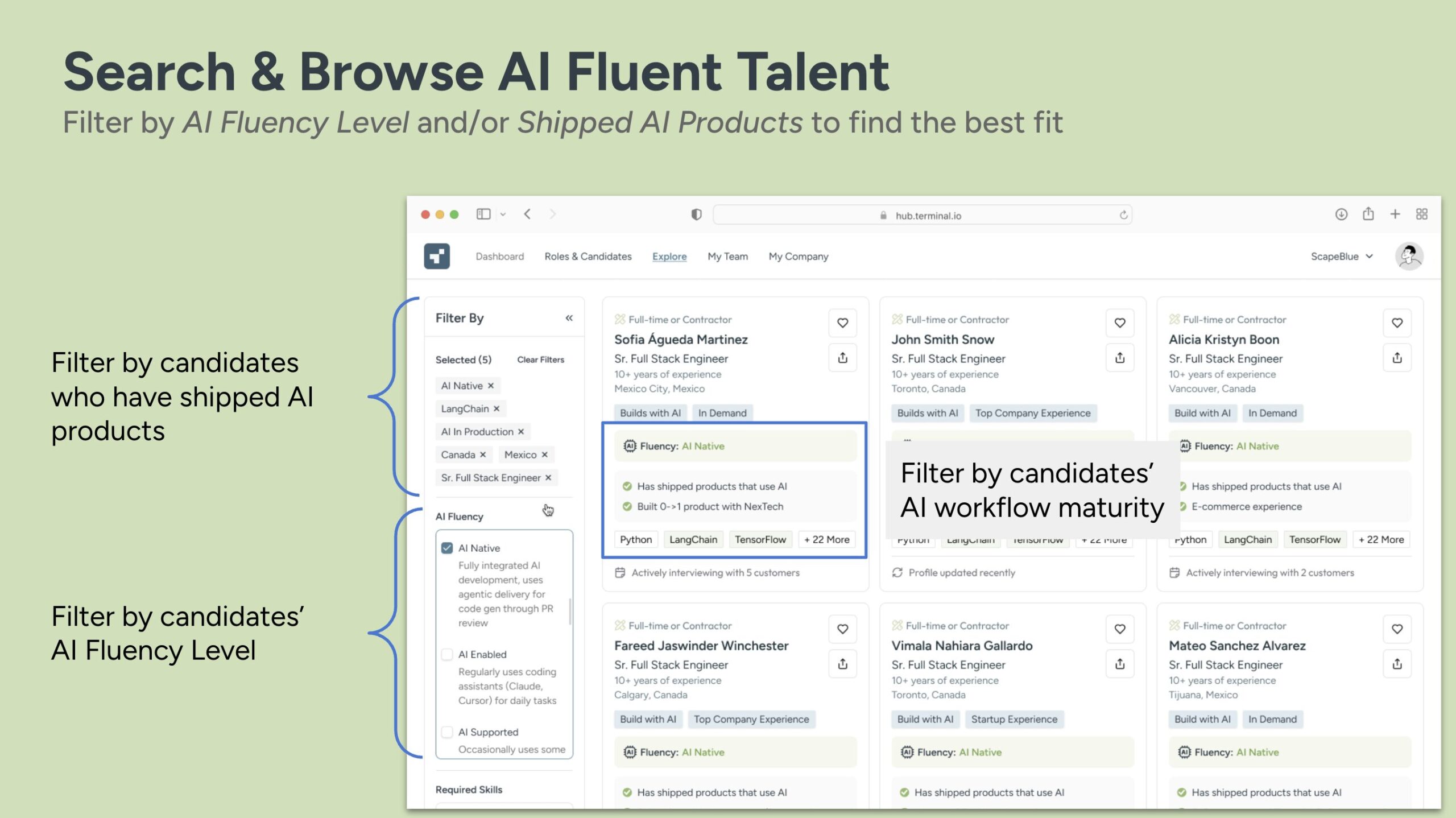
Our AI fluency standard gives engineering and talent leaders an easy way to identify AI fluent talent, but Dylan and Paolo shared an interesting perspective when it comes to interviewing for AI fluency right now: Don’t ask about AI directly. Instead, ask situational questions about how a candidate’s development workflow has concretely evolved over the past few months, or walk chronologically through their standard software delivery process. True fluency always reveals itself in the granular, hard-earned specificities of execution.
You can watch the full webinar recording here to follow the complete discussion and see how engineering teams are adapting to the AI era in practice.